Water: The One Supply a Fake Alert Can't Fake
The short answer
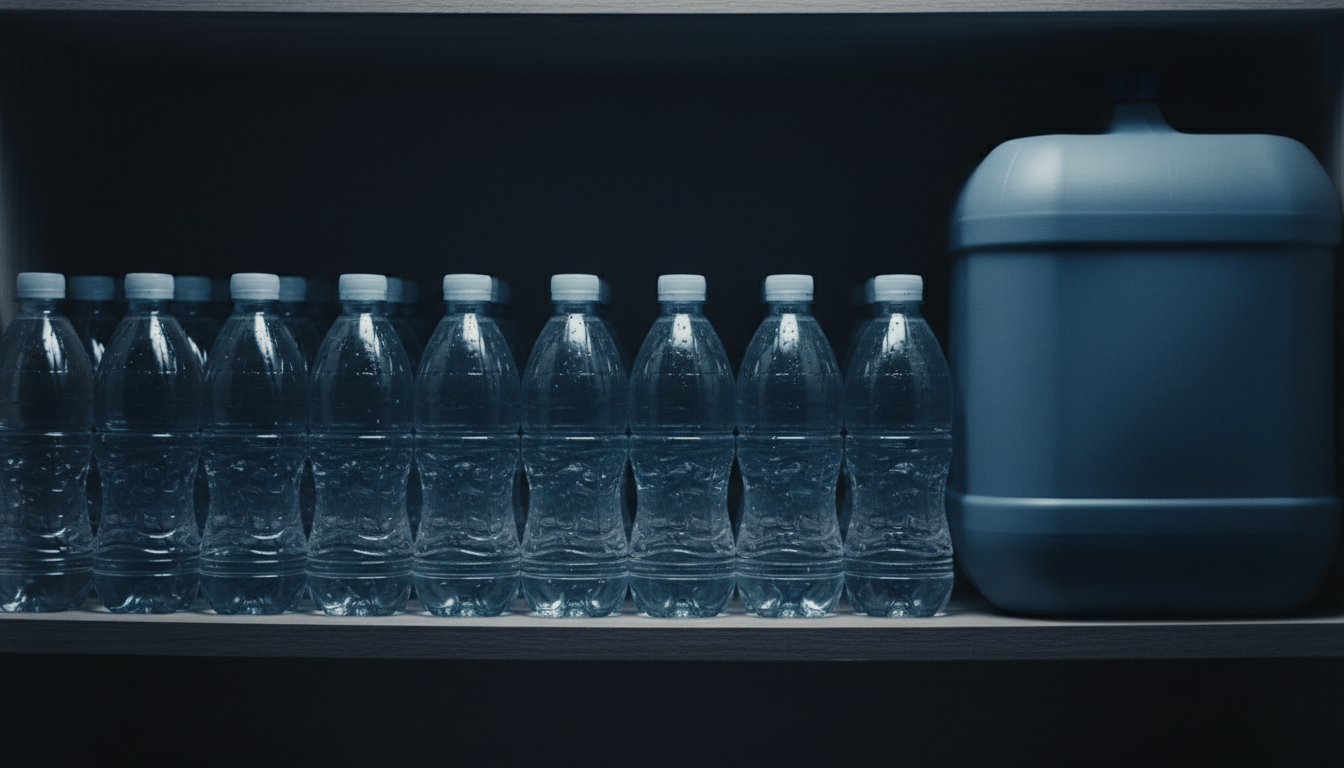
Before the food buckets, before the gear, before anything with a brand name on it: water, one gallon per person per day, at least three days of it, stored in your house. That figure is not prepper folklore — it is Ready.gov's (FEMA's preparedness site, "Build A Kit," last updated July 1, 2026) and the CDC's, and it costs less than a pizza night. This month's deep dive is about fake alerts and staged signs. Here is the connection nobody makes: a fake alert can only panic a household that has to move right now. Three days of water buys you the one thing deception cannot survive — time to think.
The numbers (official, dated)
- How much: 1 gallon per person per day, for drinking and sanitation (Ready.gov, "Build A Kit," updated July 1, 2026). A family of four needs 12 gallons for three days.
- How long: store at least 3 days' worth; try for a 2-week supply if you have the space (CDC, "How to Create an Emergency Water Supply"). Britain's national "Be Ready" campaign, launched October 22, 2026, landed on the same three-day household standard — water, food, flashlight, power bank, radio, first aid, cash.
- Hot weather: in very hot temperatures, water needs can double (Ready.gov). Georgia exists. Plan accordingly.
- Pets, nursing mothers, anyone sick: they need more, and the gallon is a minimum, not a target (Ready.gov; CDC).
How to store it (CDC method)
- Containers: FDA-approved food-grade water containers with tight lids. Never a container that once held anything toxic — no old bleach jugs, no chemical bottles, no exceptions (CDC).
- Sanitize before filling: wash the container, then rinse it with a solution of 1 teaspoon of unscented liquid household bleach (5–9% sodium hypochlorite) in 1 quart of water (CDC).
- Fill, label, date: write "drinking water" and the date on every container. Store cool, dark, and away from gasoline, pesticides, and anything you'd never want in a glass of water (CDC).
- Rotate: water you filled yourself gets replaced every 6 months (CDC; Ready.gov). Unopened commercially bottled water is the simplest option of all — CDC calls it the safest and most reliable emergency source — and it keeps to the date on the bottle.
- The cheap start: you do not need a system. Two cases of bottled water and a marker beat a $400 filtration altar you never set up. Start ugly. Start today.
If you ever have to treat water (CDC, emergency guidance)
- Boiling is best: bring clear water to a rolling boil for 1 minute, let it cool, store it covered (CDC).
- Bleach, if you can't boil: use plain, regular, unscented household bleach, 5–9% sodium hypochlorite — no scented, color-safe, or splash-less products. Add 8 drops per gallon of clear water (about ½ mL, a little less than ⅛ teaspoon), stir, and let it stand at least 30 minutes. If the water is cloudy, murky, colored, or very cold, double the amount — and let cloudy water settle and filter it through a clean cloth first (CDC, "How to Make Water Safe in an Emergency").
- Know the limit: boiling and bleach kill germs. Neither fixes water contaminated with fuel or chemicals. If it smells like a gas station, it is not a beverage, no matter what you add to it (CDC).
Why this is November's tip
On November 17, the nationwide alert test runs for one minute. It is a test. But the June hack in Brazil — ten fake "Extreme Alert" messages, ~30 million phones, one stolen password — showed what a fake alert can do to people who believe they have no margin. Nobody in this house is building a bunker. We are filling jugs. Proverbs 22:3: "The prudent sees danger and hides himself, but the simple go on and suffer for it." Preparation is not fear. Preparation is what makes fear a bad investment for anyone trying to sell it to you.
Next in the rotation: food storage (December) — what a two-week pantry actually looks like without buying a single freeze-dried entrée.
Sources: Ready.gov (FEMA), "Build A Kit," last updated July 1, 2026 — 1 gallon per person per day for several days; water needs can double in heat. CDC, "How to Create an Emergency Water Supply" and "How to Make Water Safe in an Emergency" — 3-day minimum, 2-week goal, food-grade containers, sanitize at 1 tsp bleach per quart, replace self-filled water every 6 months, boil 1 minute, 8 drops of 5–9% unscented bleach per gallon (double if cloudy/cold), 30-minute stand. UK Government "Be Ready" campaign, launched October 22, 2026 — three-day household supplies standard.
It's In The Fan — www.itsinthefan.com
Back to Survival