There Were
Giants.
Every ancient culture remembers them.
Scripture names them. Archaeology keeps finding bones that don't fit.
And there's a mound near your town that might explain why.
See the EvidenceTrack 1: The Texts
Scripture + world tradition.
This track maps the giant lineage claim: what the Bible says, how ancient tradition interprets it, and why the same story appears worldwide.
Genesis 6:4 — The Nephilim
"There were giants in the earth in those days; and also after that, when the sons of God came in unto the daughters of men, and they bare children to them, the same became mighty men which were of old, men of renown." The Hebrew term rendered as "giants" is Nephilim, from the root naphal ("to fall"). The passage presents an origin claim: the "sons of God" (bene ha’elohim) took human women and produced offspring described as mighty men of renown.
What this supports: Scripture treats giants as historical beings and ties their origin to a non-human/human crossing event — not simply tall tribes or metaphor.
Numbers 13:33 — The Spies’ Report
"And there we saw the giants, the sons of Anak, which come of the giants: and we were in our own sight as grasshoppers, and so we were in their sight." The Israelite scouts reported encountering the Anakim in Canaan and described them as descendants of giants.
What this supports: The giant tradition is not confined to Genesis. It appears again as a present-tense reality inside Israel’s historical narrative.
Deuteronomy 3:11 — King Og’s Bed
"For only Og king of Bashan remained of the remnant of giants; behold his bedstead was a bedstead of iron... nine cubits was the length thereof, and four cubits the breadth of it." The text points to a measurable artifact associated with a giant king.
What this supports: The biblical text anchors the claim in physical scale — not just story language — by referencing an object with dimensions.
1 Enoch 7 — The Watchers’ Offspring
1 Enoch expands the Genesis 6 framework by describing the Watchers producing giant offspring and teaching forbidden knowledge. In the Enochic tradition, the giants become predatory and violent, accelerating human corruption.
What this supports: Ancient Jewish tradition preserved a detailed interpretation of Genesis 6 that explicitly frames the giants as the result of a forbidden crossing between realms.
A worldwide memory of ‘sky people’ and giants
Across cultures, you see recurring motifs: beings associated with the sky/heavens, unusual knowledge transfer, hybrid bloodlines, and giant warrior clans. The names differ, but the pattern repeats — independent oral and written histories pointing to the same kind of event.
What this supports: Even if you disagree on interpretation, the cross-cultural consistency is the signal: giants are not a single-region myth — they’re a global tradition.
Working thesis: Giants are repeatedly described as the downstream result of non-human interaction with humanity — a lineage event. The modern NHI framing (genetics, hybridization, reproduction) mirrors the ancient framing (Watchers, forbidden unions, corrupted bloodlines). The names change. The mechanism stays familiar.
Track 2: The Mounds
There's a mound near your town.
Across America, thousands of earthen mounds mark the landscape. Local legends, tribal oral histories, and 19th-century excavation reports tell the same story: the builders were giants. And the bones keep disappearing.
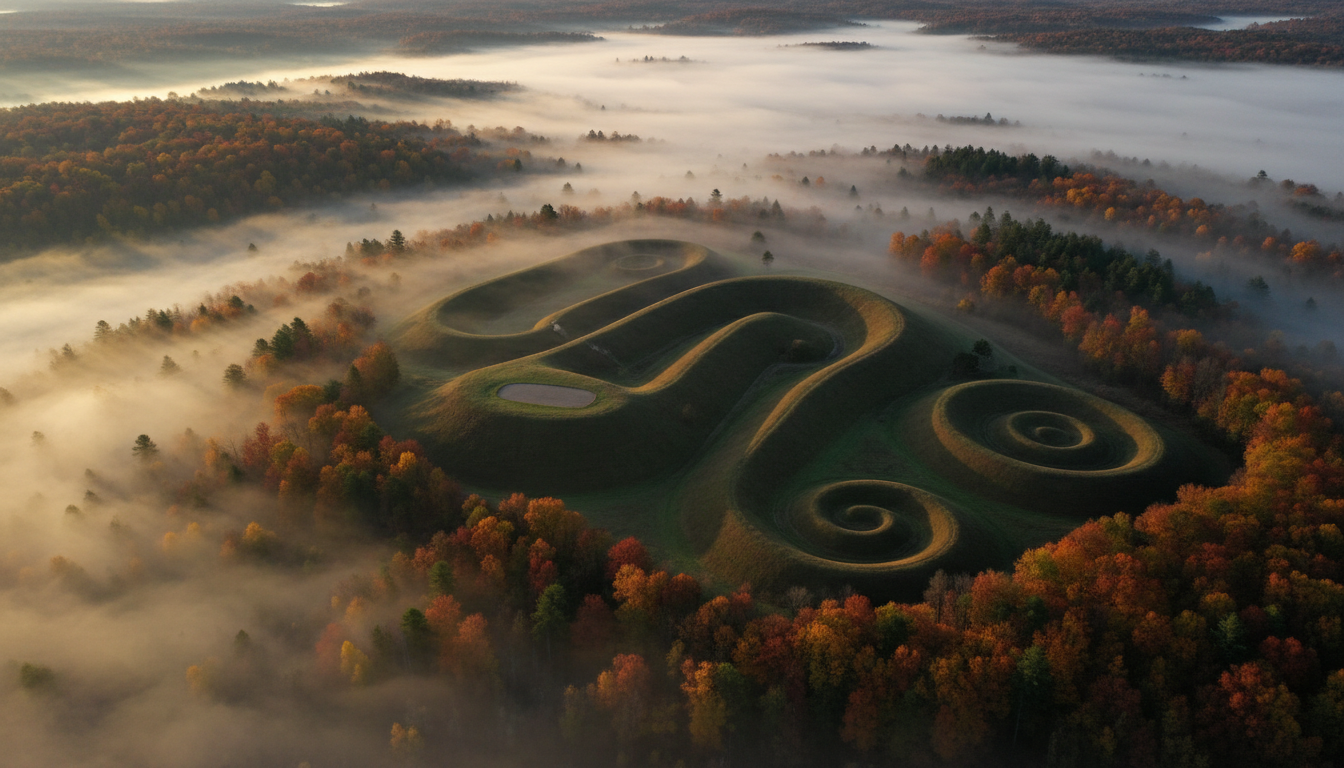
Thousands of mounds dot the American landscape. Most people drive past them every day without knowing what's underneath.
Cahokia Mounds — Collinsville, Illinois
The largest pre-Columbian settlement north of Mexico. Monks Mound alone covers 14 acres and stands 100 feet tall — larger at its base than the Great Pyramid of Giza. Early European explorers and 19th-century excavators reported finding oversized skeletal remains in burial mounds throughout the complex. The Smithsonian's Bureau of Ethnology conducted extensive excavations in the 1880s-1890s. Many of those remains have never been publicly displayed or accounted for.
Local legend: Local Illini and Osage oral traditions describe a race of giant builders who constructed the mounds before their people arrived.
Serpent Mound — Adams County, Ohio
A 1,348-foot-long effigy mound in the shape of a serpent. No burials have been found within the serpent itself, but nearby conical mounds contained oversized skeletal remains when excavated in the 1880s. The mound aligns with solar and lunar events, suggesting astronomical knowledge far beyond what's attributed to its builders.
Local legend: Delaware (Lenape) tradition speaks of the Allegewi — a powerful race of giants who once controlled the Ohio Valley. The Delaware and Iroquois allied to drive them out in a great war.
Moundsville — West Virginia
The Grave Creek Mound stands 62 feet tall and 240 feet in diameter — one of the largest conical mounds in the Americas. Excavated in 1838, workers reported finding multiple burial chambers containing skeletons of unusual size, along with copper bracelets, mica ornaments, and a controversial inscribed stone tablet.
Local legend: The town is literally named after the mound. Local Adena culture legends describe the mound builders as a separate, larger race that preceded the tribes known to history.
Etowah Mounds — Cartersville, Georgia
A major Mississippian culture site with six mounds, including a 63-foot platform mound. Excavations revealed elaborate burials with copper plates, shell gorgets, and stone effigies. Reports from 19th-century digs reference skeletal remains of unusual proportions. The site was a political and ceremonial center for a vast chiefdom.
Local legend: Cherokee oral tradition includes accounts of a race called the Nunnehi — powerful beings of great stature who lived in the mounds and could appear and disappear at will.
Spiro Mounds — Le Flore County, Oklahoma
Called the 'King Tut of the Arkansas Valley.' When commercially looted in the 1930s, the Craig Mound yielded one of the richest artifact collections ever found in North America — including engraved shell cups depicting giant warrior figures, copper plates, and elaborate burial goods suggesting a ruling class of extraordinary status.
Local legend: Choctaw and Caddo traditions describe ancient giants who built the mounds as temples and burial sites for their chiefs.
Lovelock Cave — Pershing County, Nevada
Excavated in 1911 after a guano mining company broke through the cave floor. Archaeologists recovered thousands of artifacts including duck decoys, woven baskets, and — according to multiple contemporary accounts — oversized human remains with red hair. Most of the skeletal material was reportedly sent to museums and has since been 'lost' or reclassified.
Local legend: Paiute oral tradition explicitly describes the Si-Te-Cah: red-haired, cannibalistic giants who terrorized the region until the Paiute trapped and burned them in the cave.
Kanawha Valley — West Virginia
In the 1880s and 1890s, the Smithsonian's Bureau of Ethnology excavated dozens of mounds throughout the Kanawha Valley. Field reports — some of which survive in the Bureau's own annual reports — document the recovery of skeletons measuring 7 to 9 feet in length, with unusually thick skulls and double rows of teeth in some cases.
Local legend: Multiple tribal traditions in the region describe a race of giants who were eventually driven south by allied tribes.
Catalina Island — California
Ralph Glidden excavated over 800 burials on Catalina Island between 1919 and 1928, claiming to have found numerous skeletons over 7 feet tall, with some reportedly reaching 9 feet. His collection was eventually acquired by the Catalina Island Museum. The oversized remains have been disputed, reclassified, or are no longer available for examination.
Local legend: Tongva (Gabrielino) tradition includes accounts of giant ancestors who once inhabited the Channel Islands.

Where did the bones go?
Between 1880 and 1920, the Smithsonian's Bureau of Ethnology conducted thousands of mound excavations across the eastern United States. Their own annual reports document the recovery of oversized skeletal remains — 7, 8, even 9 feet tall. Those remains were shipped to the Smithsonian. Most have never been publicly displayed, cataloged, or accounted for. When researchers request access, they're told the specimens were "lost," "misidentified," or "destroyed."
How to check your own town
If you live east of the Mississippi, there's almost certainly a mound site within 50 miles of your home. Here's how to find out:
Search '[your county] mound site' or '[your county] Indian mound' — most states have archaeological surveys online.
Check your local historical society or county museum. Ask about 'mound builder' artifacts or excavation records from the 1800s.
Look for town names: Moundsville, Mound City, Mound Bayou, Mounds View — the name often tells you exactly what's there.
Search old newspaper archives (newspapers.com) for your county + 'giant skeleton' or 'giant bones' — 19th-century papers reported these finds routinely.
Ask local Native American communities about their oral traditions regarding the mound builders. Many tribes have specific names for the giants.
The pattern: Mound sites across America share the same story: local tribes describe a race of giants who built them. 19th-century excavations found oversized remains. Those remains were sent to institutions. The institutions say they're gone. The mounds are still there. The legends are still there. The bones are not.
Track 3: The Artifacts
Claims, provenance, and red flags.
Archaeological claims require evidence. Here's what's documented, what's disputed, and what keeps disappearing.
The New York Times — 1902
A December 1902 article in the New York Times reported the discovery of giant skeletons in a mound near Miamisburg, Ohio. The remains were described as being over 8 feet in length with unusually thick skulls. The article treated the find as newsworthy but unremarkable — giant skeleton discoveries were routinely reported in major newspapers throughout the 19th and early 20th centuries.
Bureau of Ethnology — 12th Annual Report (1894)
The Smithsonian's own Bureau of Ethnology documented the excavation of mounds throughout the eastern United States. Multiple entries describe skeletal remains of unusual size — 7 to 8 feet — recovered from burial mounds in West Virginia, Ohio, Tennessee, and Illinois. These are not fringe claims. They're in the Smithsonian's own published reports.
Abraham Lincoln's Giants Reference
In an 1848 speech, Abraham Lincoln referenced the 'race of giants' whose bones were found in the mounds of the Mississippi Valley as a matter of common knowledge. He wasn't making a controversial claim — he was citing what was widely accepted at the time. The question isn't whether giant bones were found. The question is what happened to them.
Giant Skeletons of Lovelock Cave (1911-1924)
Multiple excavations at Lovelock Cave, Nevada recovered artifacts and human remains. Contemporary accounts from archaeologists L.L. Loud and M.R. Harrington describe oversized skeletal remains with red hair. The Humboldt County Museum displayed some remains for years. The oversized specimens have since been removed from public access or reclassified.
The Confiscation Pattern
Across dozens of documented cases from the 1800s through the early 1900s, the pattern repeats: giant bones are discovered during mound excavation → local newspapers report the find → specimens are sent to the Smithsonian or a state museum → the specimens are never publicly displayed → when researchers inquire, they're told the remains were 'lost,' 'misidentified,' or 'destroyed.' This pattern is too consistent to be coincidence.
Discernment: Not every claim of giant bones is legitimate. Hoaxes exist — the Cardiff Giant (1869) was a famous fraud. But the existence of hoaxes doesn't invalidate the documented finds in Smithsonian reports, newspaper archives, and tribal oral histories. Separate the signal from the noise. Look for primary sources. Verify provenance. And ask the obvious question: if these finds were all hoaxes, why did institutions confiscate them?
Sources & Further Research
Fact-check everything. These are starting points, not conclusions.
Smithsonian Bureau of Ethnology — Annual Reports (1880s-1890s)
Original field reports documenting mound excavations and skeletal finds
The Book of Enoch (R.H. Charles translation)
Complete English translation of 1 Enoch with scholarly notes
Lovelock Cave Archaeological Reports
L.L. Loud and M.R. Harrington excavation documentation
Tim Alberino — Birthright (Book)
Investigative research into the Nephilim, ancient giants, and forbidden archaeology
L.A. Marzulli — On the Trail of the Nephilim
Field research and photographic evidence of elongated skulls and giant remains
Jim Vieira — Stone Builders, Mound Builders
Research into giant skeleton newspaper accounts and megalithic construction
The Biblical Anchor
The giant tradition isn't a side note in Scripture — it's woven throughout the entire narrative. From Genesis to David and Goliath to the conquest of Canaan, the Bible treats giants as historical reality, not metaphor. The Nephilim weren't fairy tales. They were the reason for the flood.
"And there we saw the giants, the sons of Anak, which come of the giants: and we were in our own sight as grasshoppers, and so we were in their sight."
— Numbers 13:33
If the Bible is true — and we believe it is — then giants were real. The question isn't whether they existed. The question is why the evidence keeps being hidden.
Don't Miss Next Month's Deep Dive
Subscribe to get notified when we publish our next conspiracy investigation.
Subscribe for Updates